Sewer Line Replacement in Phoenix, AZ
When the camera shows collapsed, flattened or failing pipe, replacement is the fix that ends the callbacks. Call and we connect you with a licensed Valley sewer contractor for an itemized quote, trenchless where it works and a trench only where it has to.
Phone lines open Mon to Sat, 7am to 7pm
When replacement is the right answer
If only one or two sections are bad, a spot repair or liner is usually the better value. See the repair ladder.
- The pipe has collapsed, or the camera cannot pass
- Orangeburg fiber pipe that has gone oval or flat (common in homes from about 1940 to 1970)
- Deep bellies along the line that hold standing water
- Damage spread along most of the run, so spot repairs would be a patchwork
- You are remodeling or adding a bathroom and the existing line is undersized or failing
Trenchless replacement vs open trench
Pipe bursting pulls a new HDPE pipe through the old one from a launch pit to a receiving pit. It replaces the pipe entirely and can upsize it, with two small excavations instead of a trench.
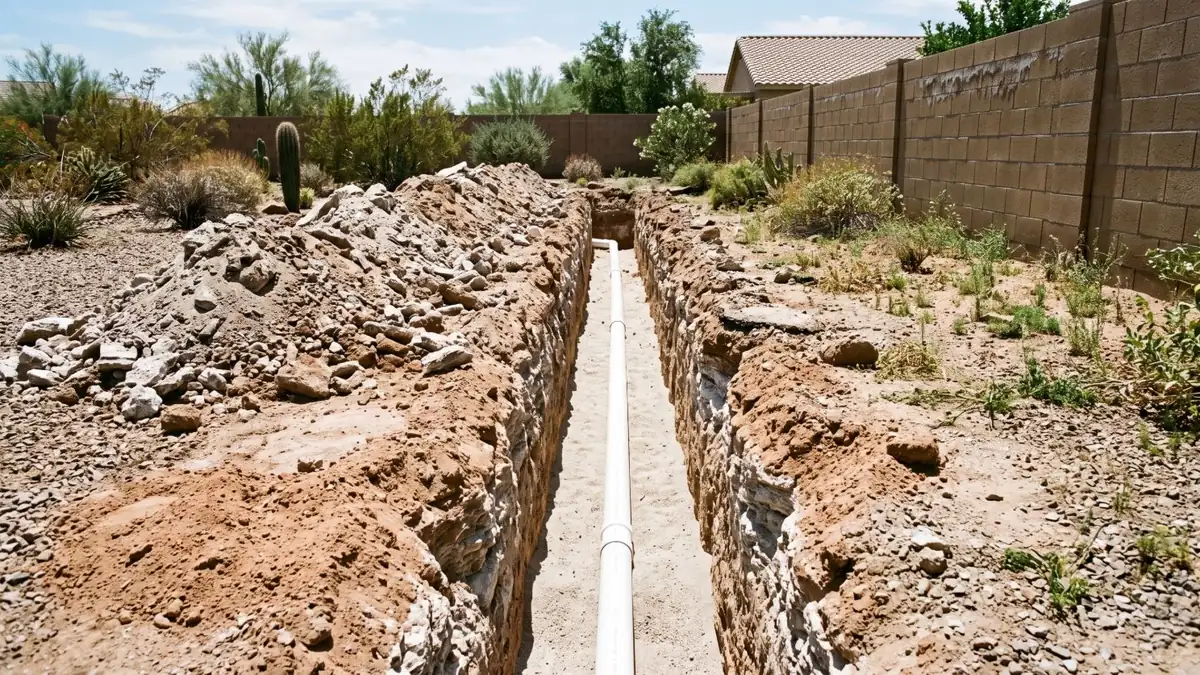
Open trench means digging along the full line, removing the old pipe and laying new PVC or ABS at the correct slope. It is the right call when the grade has to be corrected (deep bellies) or when other utilities crowd the path. In Valley soils with caliche, trenching can take longer and cost more (University of Arizona Extension).
Many jobs combine both: dig out a collapsed section, then line or burst the rest.

A sample itemized Phoenix sewer replacement estimate
No competitor we reviewed publishes line items, so here is what a complete replacement quote should break out. Ranges are from published cost guides; use this to check that nothing is missing from yours.
Swipe table →
| Line item | What it covers | Published range |
|---|---|---|
| Diagnostic visit | Service call and assessment | $100 to $250Phoenix |
| Camera inspection and locate | Video, footage marks, depth | $245 to $350Phoenix, under 50 ft |
| Permits | City plumbing permit and inspection; right-of-way permit if the street or sidewalk is opened | Phoenix right-of-way permit about $150 per Angi; plumbing permit varies by city |
| Replacement, per foot | Excavation or pits, pipe, fittings, labor | $45 to $280 per ft(Phoenix); PVC $50 to $120 per ft installed |
| Trenchless alternative, per foot | Bursting or lining instead of trenching | $64 to $260 per ftPhoenix |
| New cleanout | Access point for future maintenance | Ask for it as its own line |
| Restoration | Concrete, pavers, landscaping, irrigation repair | Often excluded; get it in writing |
| Final camera | Video proof of the finished line | Should be included |
Sources: Angi, Phoenix sewer line cost, Angi, Phoenix trenchless, Angi, Phoenix camera inspection. Checked September 2026.
How to compare two replacement quotes
- Same length? Quotes are often per foot; confirm both measured the same run from the camera locate.
- Same method? Bursting, lining and trenching are priced differently for good reasons.
- Is the permit included, and who pulls it?
- Is restoration included, and to what standard (concrete, pavers, desert landscaping, drip lines)?
- Is there a final camera video and a written warranty with a clear term?
- Is the contractor licensed? Check the license number at roc.az.gov. In Arizona, sewer and plumbing work over $1,000, or any work needing a permit, requires an ROC license.
Pipe materials: what goes back in the ground
Whatever the material, the quote should state the pipe type and diameter (most residential laterals are 4 inch). If a contractor proposes upsizing, ask why.
- PVC (usually SDR-35 or Schedule 40 for sewer laterals): the standard for open-trench replacement. Smooth, root-resistant glued joints, and the most common material you will see quoted.
- ABS: black plastic drain pipe that replaced cast iron in many Valley homes after about 1970. Still widely used for drain lines inside homes.
- HDPE (high-density polyethylene): the fused, jointless pipe pulled in by pipe bursting. No joints means no place for roots to enter.
- Liner (CIPP): not a new pipe, but a resin tube cured inside the old one. Counts as a rehabilitation rather than a replacement, and is priced per foot.
Who is responsible for which section
Phoenix property owners are responsible for the building connection from the house to the public sewer. For single-family homes and duplexes, the City repairs a broken section inside the public right-of-way; for other properties, the owner handles it and needs a City permit before working in the right-of-way (City Code 28-5). Rules differ by city: in Scottsdale the owner is responsible all the way to and including the tap on the main (Scottsdale Water).
What replacement day looks like
Most residential trenchless replacements take a day. Open-trench jobs can take two to several days depending on length, depth and restoration.
- Locate and mark the line; the contractor calls Arizona 811 to mark other utilities before digging
- Open the pits or trench; water use in the house pauses
- Pull, burst or lay the new pipe; connect to the house and to the lateral at the property line or main
- City inspection before backfill where required (Tempe, for example, requires Building Safety to inspect before the line is covered)
- Final camera, backfill and restoration
Sewer line replacement cost in Phoenix at a glance
Swipe table →
| Job | Typical range | What moves the price |
|---|---|---|
| Full replacement (typical total) | $1,818 to $6,429avg. $4,123 | Length, depth, method, restoration |
| Per foot, installed | $45 to $280 per ft | Trench vs trenchless, access |
| Trenchless replacement (total) | $1,963 to $6,198 | Number of pits, pipe size |
| National, 40 ft line | $2,000 to $10,000 | Useful sanity check for longer runs |
Sources: Angi, Phoenix, Angi, Phoenix trenchless, HomeGuide. Checked September 2026. Local contractors publish higher all-in ranges (about $3,500 to $12,000), so expect quotes above the averages when restoration is included.
Sewer Line Replacement: common questions
How long does sewer line replacement take?
A typical trenchless replacement takes about a day. Open trench jobs take longer, especially with caliche, long runs or concrete to restore.
How deep are sewer lines in Phoenix yards?
It varies by lot and slope. The camera transmitter measures the depth at each point, which is why the locate belongs in every quote.
Does pipe bursting make the pipe smaller?
No. Bursting can keep the same size or upsize the line, because the old pipe is broken outward and the new pipe replaces it.
Does homeowners insurance cover sewer line replacement?
Usually not for wear, roots or age. Check your policy and any service line warranty exclusions before work starts.
Related services
Trenchless Sewer Repair
Line or burst a failing sewer pipe through one or two small access pits instead of trenching the yard.
Read the guide →Sewer Camera Inspection
See inside the line before you buy a home or pay for a repair. Video plus a plain-English read of what it shows.
Read the guide →Sewer Line Repair
Backups, gurgling drains, sewage smell. Find the cheapest fix that actually works, from cleaning to a spot repair.
Read the guide →Also available in Glendale, Tempe, Mesa, Scottsdale.
Serving Phoenix and the surrounding Valley
We connect homeowners across the Phoenix metro with licensed local sewer contractors: central Phoenix and Ahwatukee, plus Tempe, Scottsdale, Mesa and Glendale.
Also covering: Chandler, Gilbert, Peoria, Paradise Valley, Sun City.